
creature feature: japan
the horrors of japanese folklore
In a time when the news cycle is exhausting, sometimes we need a break from the everyday horrors, so we turn to the supernatural ones.
And what better way to get the chills than a good old creature feature?
Sure, we could discuss vampires or werewolves or the Mothman, but last time I checked, you didn’t have to be afraid the Mothman was going to drown you in a toilet and make streamers out of your intestines.
(I mean, I guess I can’t say for certain he wouldn’t…but…it doesn’t feel like his M.O.)
Some of you might know where I’m going with this, but for those who aren’t aware you always need to be vigilant of toilet demons—we’re heading to the land of the rising sun for some truly terrifying folk tales and a dangerous game to play in the dark.
As some of you may have seen, we’re doing things differently at cursed objects.
In these times, we all need a bit of joy, so we’re no longer paywalling our content. If you enjoy this content and would like to support the time and effort that goes into this little folklore substack, you can become a monthly or annual subscriber, or you can give a one-time donation through a link to contribute at the end of every story.
And if you just want to enjoy these stories, that’s okay too.
So, if you haven’t already subscribed, now would be a great time to make sure you never miss a new edition of cursed objects.
the jorōgumo.
We’ve all done it at least once—freaked out at a tiny eight-legged trespasser in our home.
Maybe you were kind enough to take it outside, or, perhaps, like most people, you squished it, squashed it, vacuumed it up, or sent it to a watery grave down the drain.
But what if I told you that killing one of these tiny creatures might lead to your own untimely end?
So, let’s talk about a creature that might make you think twice about killing an eight-legged intruder:
It’s an entity known as a Jorōgumo, and its favorite thing to do is transform into a beautiful woman to lure unsuspecting men to their deaths so it can suck the flesh from their bones.
The Jorōgumo is a type of yōkai (demon) that begins its life as a regular little spider, and depending on where you are, you might even have a few hanging around your house.
You might have heard of jorō spiders before. They’re the little guys who turn their webs into kites so they can fly. Young jorō spiders can use the wind to fly distances of up to one hundred miles (horrific).
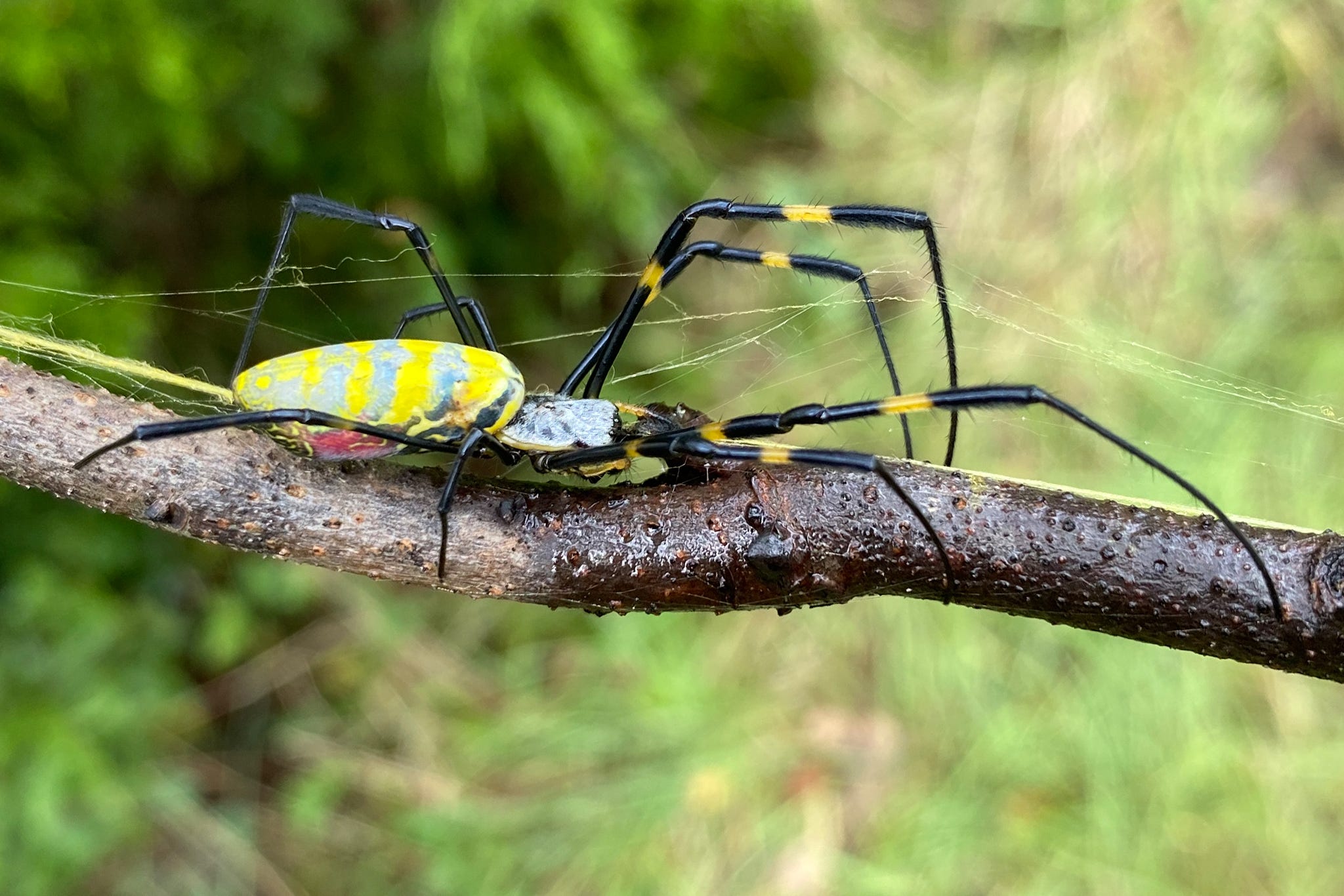
Jorō spiders are known for their bright yellow and blue coloring and weaving massive webs of up to six feet out of silk that has a distinct golden hue. They can grow to be up to four inches in length and are relatively harmless to humans and other animals.
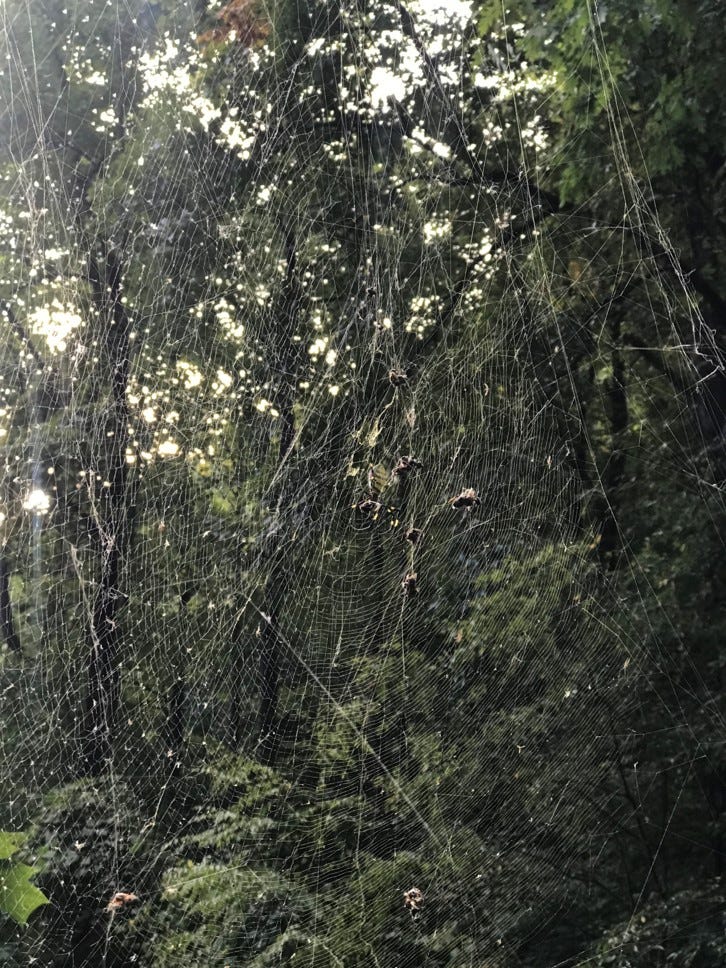
You can get bitten by a jorō spider, but it’s rather unlikely you’ll even feel the bite. Their fangs are quite short and struggle to pierce the skin, but if one does manage to chomp down hard, you’ll get a bit of venom equivalent to a bee sting.
Now, legend has it that if a jorō spider lives to be 400 years old, it will become a yōkai and have the ability to transform itself into the shape of a beautiful woman. However, as with any magic, there’s always a price. Unlike a normal spider, a Jorōgumo can’t sustain itself off insects anymore; it requires human flesh and blood to survive.
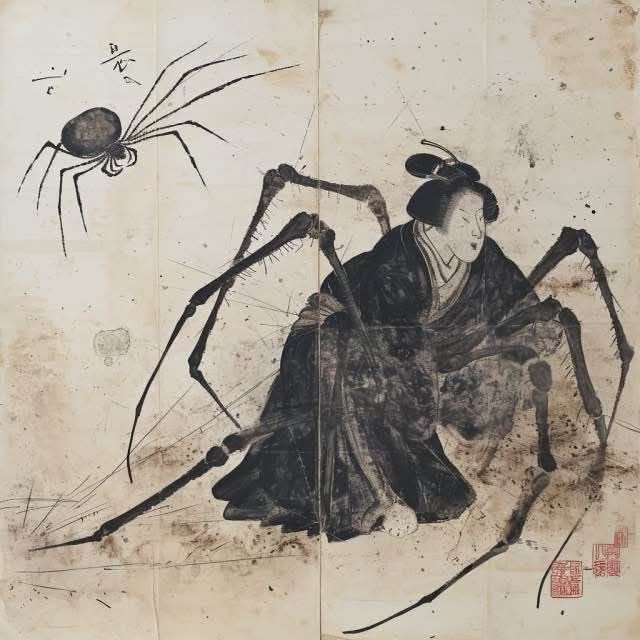
Written in modern kanji, Jorōgumo means “entangled bride,” but hidden within the word is its original intended meaning: “whore spider.”
Why are we calling spiders whores?
Well, there are many different stories about this entity, but one of the more well-known tales comes from the city of Izu in the Shizuoka Prefecture during the Edo period (1603-1867).
The story goes a little something like this:
A long time ago, a woodcutter sat by the basin of Jōren Falls to rest his weary bones and enjoy the lunch his wife had prepared for him.
As he unwrapped the carefully packed meal, he felt something hit his leg. The man looked down to find a strange sticky substance on his ankle. He wasn’t quite sure what it was but assumed it was likely some sort of sap. So he wiped it off on a log beside him and went back to unpacking his meal.
As he took his first bite, the log that he’d wiped the strange substance on suddenly flew from the shore beside him back behind the falls.
The woodcutter was baffled by what he just witnessed, but his mama didn’t raise no fool, and he decided to find a different location to eat his lunch.
Over the years, many people disappeared in the area around Jōren Falls, but most people assumed they’d either met with foul play or had gone there to commit suicide.
It wasn’t until another woodcutter had a strange experience at the falls that the residents of Izu realized why so many people had vanished over the years.
This woodcutter was a man new to the area, unfamiliar with stories of strange happenings around the falls. So, as he wandered the area, he was shocked by the number of untouched trees near the water and assumed he’d struck gold.
But the day was hot, and the man’s palms became slick with sweat, making it difficult to hold onto the handle of his axe.
As he went to swing, the axe slipped from his hands and flew into the basin. The man started to panic. He could not swim, but he also could not afford another axe. Just as he began to lose hope, a creature appeared from behind the waterfall. It had the face and naked torso of a woman, but the lower body of a large spider.
The man fell to the ground in fear, but the creature assured him it meant him no harm. The creature descended into the water and retrieved his axe.
She handed the axe to the man and made him promise that in return for this favor, he must never tell another living soul what he saw that day.
Unfortunately, the woodcutter was a man with loose lips after a few drinks and only managed to keep the secret for a few days before spilling the entire story at a town banquet.
As he finished the story, he was pulled outside as though tethered by some invisible string.
The other attendees thought nothing of it at the time, as the woodcutter was very drunk, but when his body was found the next day floating in the basin, half stripped of flesh, they realized his story about the half-naked spider lady was true.
After that, the people of Izu began to avoid the area around the falls, but merely staying away wasn’t enough to keep everyone safe.
You see, the Jorōgumo wasn’t bound to the waterfall.
The townspeople didn’t know it, but the creature had the power to shapeshift into a full human. It didn’t need to stay behind the falls; it could walk into town disguised as a beautiful woman, and could even live among the townspeople if it chose to.
And so, every so often, despite the warnings and locked doors, someone would go missing and inevitably be found, ripped to shreds, floating in the basin of Jōren Falls.
I suppose the stories don’t really explain why the hidden meaning within the word Jorōgumo is “spider whore.”
Well, as the legend evolved over the years, the Jorōgumo shifted from a forest-dwelling entity who occasionally helped or devoured men to an irresistible femme fatale shapeshifter who seduced men, luring them back to its lair to suck the flesh from their bones or, at the very least, drain their youth and vitality.
Now, you might think you’re safe if you’re not a man who is easily lured to isolated places by a pretty face, but while men are a Jorōgumo’s preferred meal of choice, they’ll happily take a bite out of anyone who bothers them or one of their many spider friends.
There are many stories of a Jorōgumo creeping into the dreams of an unsuspecting victim or sending thousands of spiders to attack someone who has wronged an innocent arachnid.
So, the next time you’re thinking about squishing that pesky little spider in the corner, just remember it might have a much bigger friend with incredibly sharp teeth and an appetite for human flesh.
Thankfully, though, most jorō spiders only live for about a year, so while your chances of crossing paths with a Jorōgumo are slim, there’s still a .0001% chance.
But, while the story of the Jorōgumo is hopefully more folklore than fact, it’s still a good reminder to be wary of the woods and respectful of nature.
It’s also a reminder that if your Tinder match seems too good to be true, you probably should be a little leery of why they’re so eager to get you back to their place…
kuchisake-onna.
Our next tale is about an entity called Kuchisake-onna (the Slit-Mouthed Woman), and let’s just say she’s not someone you want to run into on an empty street late at night…
Long ago in feudal Japan, a samurai discovered his favored concubine was unfaithful.
The samurai decided the only way to ensure his concubine’s faithfulness was to make sure no man would ever look at her again. So, he took a blade and carved a bloody grin on her face, slicing her from ear to ear.
It’s unclear if the samurai ultimately killed his concubine during this attack or if she lived out her life disfigured. More modern versions of the myth swap the cruel samurai and his adulterous concubine with a jealous husband abusing his wife, but both versions end the same way: the woman’s rage and suffering were profound enough to transform her spirit into an onryō after death.
Onryō are a type of spirit bound to the human world by extreme rage or sorrow. They are typically victims of violence, abuse, or a sudden tragic end. They linger on this plane sometimes with the hope of doling out justice and other times to inflict on others the same pain they felt in life. And unlike typical apparitions, onryō can interact with the physical world on their quest for justice or revenge.
And Kuchisake-onna has a particularly brutal brand of retribution.
She wanders dark roads at night looking for lone travelers to approach. Her face is usually covered by a surgical mask, and she carries a sharp object (mainly scissors) in her hand.
If you have the misfortune of running into her, she’ll ask, “Watashi, kirei?” (Am I beautiful?), and this is where it begins to get dicey.
Let’s say you go with “No.” Well, you’re about to get a bloody grin carved into your face that matches Kuchisake-onna’s.
But what if you say, “Yes”?
Well, it’s your lucky day, because you’re about to see what’s under the mask, and unfortunately it’s a bloody, dripping slash with sharp teeth.

She’ll then ask, “Kore demo?” (Am I still beautiful?).
If you scream or say “no,” sorry, but you’re about to get sliced and diced.
However, if you say “yes” a second time, you’re still not out of the woods. Kuchisake-onna will thank you and walk away, but she’ll be following you all the way home to brutally slaughter you later that night.
So, your two options are to either end your night looking like Heath Ledger’s Joker or to be brutally murdered in your own home. It’s a real Sophie’s choice.
You can try to run, but Kuchisake-onna is allegedly faster than a speeding car, but there’s another option.
A few brave souls over the years attempted to best Kuchisake-onna, and those who survived claimed the only way to escape her wrath is with a distraction.
Some say you have to provide ambivalent answers to trip her up or say “pomade” three times, while others say you should throw money or hard candy. Some say to force her hand with politeness; instead of answering “yes” or “no” a second time, you should say you’re very sorry, but you have an appointment to get to.
In the event any of this works, you should run as fast as you can to a well-lit, highly populated area and pray that Kuchisake-onna won’t come to find you when you go to bed later that night.
We don’t know a lot about the origins of the Kuchisake-onna story, but versions of it as a cautionary tale about infidelity have allegedly been around in Japan since the Edo period, and since that time there have been alleged sightings of a slit-mouth woman around Japan.
However, we don’t see concrete evidence of the story until the late 1970s, when children in the Nagasaki Prefecture began mass reporting sightings of the slit-mouthed woman, which led to a full-blown nationwide panic.
Why was there a sudden resurgence of a legend from the 1700s over two hundred years later?
Well, it’s complicated, and, as always, it’s hard to separate fact from fiction when the internet gets involved in folklore.
Allegedly, there was a coroner who, in 2007, found records of a car accident back in the 70s that involved a woman who was known for chasing children. On one such occasion, she was hit by a car, and her face was marred similar to the character in the story.
Who this coroner is and where this accident occurred is a mystery, but supposedly this explained why children were being chased by a slit-mouthed woman. And while it does provide a more logical explanation for the panic, it doesn’t explain why there were sightings across the Nagasaki Prefecture, as well as other parts of Japan.
Either this woman was incredibly ambitious in her pursuit of scaring children, or there’s another explanation.
There is another rumored origin from a reporter who traced the rumor back to Okagishi City in the Gifu Prefecture, where he found there was a woman who resided in a local mental hospital who enjoyed the occasional prison break.
Supposedly, she would cover her mouth in red lipstick and escape to hang out at the entrance of a local tunnel, where she would pop out to frighten random drivers and passersby for laughs.
It might be a compelling explanation if the woman carried a knife or attempted to attack any of the passersby, but for the most part, it seems like, if this story is true, it’s not necessarily the stuff of folklore; it’s something locals would consider a weird inconvenience of living in their town.
Now, there were many wealthy parents at the time of the panic who believed the vengeful spirit was simply an invention of poor parents trying to get their kids a leg up with entrance exams by scaring rich kids out of attending cram schools in the evenings.
And while I suppose it is possible the poor parents of Nagasaki convened and consulted a book on Edo-era folklore to find a story they could use to scare rich kids out of going to cram school so their own children could have a leg up, it would be real poor planning on their part not to let their own children know they weren’t in danger of being sliced and diced.
So, we have a bunch of weird possible explanations that have circulated over the years, but what actually happened?
It seems like it all began with a national publication, Shukan Asahi, publishing a report of an elderly woman in the Gifu Prefecture who saw the slit-mouthed woman on her way to the outhouse at night and collapsed in panic. Not long after, there was a report from the Hyogo Prefecture of a young woman arrested for wandering around with a knife, dressed up like Kuchisake-onna.
This is the part where it gets complicated.
What you have to understand about Japan in the late 70s is that cram schools were becoming incredibly popular.
In Japan, on top of having good grades, students need to take entrance exams to get into junior high, high school, and university, and there’s a significant amount of pressure around how well you do in school and on these exams because how you stack up to your peers determines everything from which school you’ll be able to attend to what classes you’ll be placed in to your future career.
Cram schools were basically private, after-hours supplemental education. Students would go after school and stay well into the evening doing mock exams and revisiting different subject areas. It’s often competitive and expensive, and many students and their families feel pressured to attend because of not wanting to be left behind both academically and socially (aka: if all my friends are in cram school and I’m at home, I’m having FOMO).
The thing about cram schools is you’re not just hanging with people you go to school with every day; you’re likely also in class with students from other private and public schools in the area.
So, in the late 70s, we have a bunch of kids from different schools and socioeconomic backgrounds together in high-pressure after-school programs. They’re coming there as soon as school ends, staying late into the evening, and often commuting home after sundown.
What likely happened was that as these news stories circulated, students began talking about Kuchisake-onna sightings, and, as kids do, the story began to evolve from a cautionary tale about the perils of adultery into a story to scare younger peers.
Remember, these are a bunch of stressed-out kids who are already burned out from long hours of studying and who are commuting when it’s dark out. They’re waiting for buses on empty streets or for trains at platforms without crowds. They’re walking home at a time when the hustle and bustle of the day is done, and it’s alarming to see someone following behind you.
So, as these stories circulated, police began receiving reports of students seeing a slit-mouthed woman on their commutes home, and police actually did take these reports seriously.
Students were encouraged to commute together, teachers would gather kids and drop them off at their homes one by one, and police patrolled the streets, worried that a very real, mentally unstable woman with a knife was running around town.
And as the story began to spread across Japan, it started to evolve, particularly as the internet became more widely available.
Newer, more modern versions of the tale began to pop up. Kuchisake-onna was no longer a concubine or an abused wife from the Edo period; she was a vengeful victim of botched plastic surgery. There started to be regional variations of how she would pursue you and how to escape. The story even made its way to South Korea.
Perhaps it’s all just a scary story, meant to teach kids about the safety of staying in well-lit areas and not wandering off the beaten path at night, but thinking back to our Bloody Mary series, it does make you wonder if it was merely a bunch of already-anxious kids succumbing to mass hysteria or if believing in something and sharing its story brings it into this world.
I suppose you’ll never know for sure unless you go looking for her.
daruma-san.
Look, I know I made a joke about Japanese toilet ghosts at the beginning, which probably led you to believe that’s what we were going to end on. And I get it; we could talk about the horrors of Japanese toilets for hours.
Who doesn’t want to be afraid a legless child is going to attack them while they’re trying to pee or that a weird hairy arm is going to reach up through the plumbing to give their cheeks a squeeze?
Who among us doesn’t want to discuss how asking the next stall over to spare a square could lead to being flayed alive?
But what if I told you that the horrors of Japanese bathrooms were not limited to the toilet? What if I told you that you could play a high-stakes game of Red Light, Green Light with a demon you summon from your bathtub?
Perhaps you didn’t know it was an option, but that changes today.
If you’ve never played Red Light, Green Light, an ever-popular American game when your elementary school gym teacher runs out of activities, it’s fairly simple:
One person is chosen as “it” and stands with their back turned to the other players at whatever marker is determined as the finish line. The other players have to close the distance between the starting point and the finish line, but they can only move when the person who’s “it” says “green light”.
Once “it” says “red light,” they can turn around, and everyone must freeze in their tracks. Any player who moves during this period is out of the game. The general goal of the game is to sneak up on whoever is “it” and make it to the finish line without getting caught by the Eye of Sauron.
In Japan, children play a similar game called Daruma-san ga Koronda, which translates to “The Daruma doll fell over.”
Instead of saying "red light” to stop players, the person designated as “it” says or sings “daruma-san ga koronda,” and once they finish the phrase, they turn around, and all players have to freeze. They can drag the ten syllables out or say it as quickly as possible to trip up players. “It” is also allowed to yell “Tomare!” or “Stop!” without looking to surprise players and stop them in their tracks.
If “it” catches you moving while you are in their sight, you are “out” and forced to join hands with them at the finish line. The goal of this game is to sneak up behind “it” and slap them on the back.
The name of the game comes from a traditional doll called a Daruma. These dolls are round, hollow dolls modeled after Bodhidharma, the founder of the Zen tradition of Buddhism.
I’m not going to get too deep into the legend of Bodhidharma, but the design of the doll is based on his lore. Supposedly, Bodhidharma, after years of pilgrimage, stopped in a cave to meditate for nine years to achieve enlightenment—nine years without moving or closing his eyes.
Unfortunately, after seven long years, Bodhidharma grew tired and fell asleep, but with three more years to go, he said, “Absolutely not,” and cut off his eyelids so he would never sleep again.
After nine years, when he finally achieved enlightenment, he lost the use of his limbs, which is why the daruma doll is limbless and has large, lidless eyes. It’s typically seen as a symbol of luck, perseverance, and resilience.
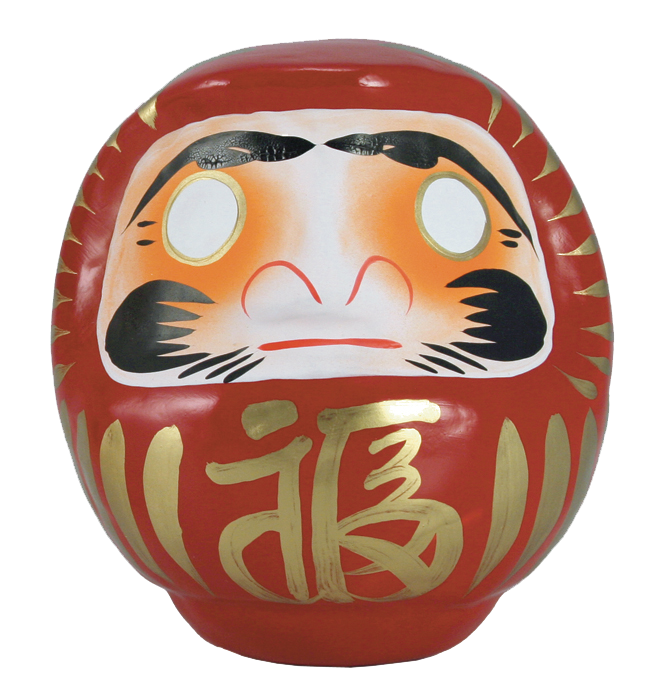
But these dolls have an interesting quirk. They have a distinct round, weighted bottom that allows them to wobble around and pop back up if they tip over, which is why they are associated with the game. You never know how fast the daruma doll will pop back up once it falls down and rolls around.
Now, you could opt to play the regular game, but it’s way more fun when you add in a bathtub demon and your life is on the line.
So, let’s play a game.

The first thing you’ll need to do is summon the entity, and the only way to do that is to take a bath right before bed.
Terrible, I know.
Fill up that tub, disrobe, close any blinds or curtains, turn out the lights (not just in the bathroom, bathe that house in darkness), and get in the tub.
Now, once you’re in the bathtub, make sure you’re facing the faucet and taps. You’re going to close your eyes and begin washing your hair. As you massage the soap in, repeat the words “daruma-san ga koronda.” Keep repeating those words until you’ve thoroughly soaped and rinsed your hair. DON’T open your eyes.
If you’ve performed the ritual correctly thus far, you’ll see an image of a woman in your mind’s eye standing up in a bathtub much like your own. As she attempts to exit the tub, she’ll slip and fall face first onto a rusty tap that pierces her right eye. You’ll watch her struggle and writhe, screaming as she tries to free herself, before slowly bleeding out, alone and afraid.
At this point in the ritual, if you are successful, the entity will make some type of appearance. But remember, you must keep your eyes closed no matter what, even if you feel a presence behind you or feel something moving in the water. If you hear or feel anything, ask aloud, “Why did you fall in the bathtub?”
You won’t receive a response.
To finish the ritual, you’ll need to stand up and get out of the tub without opening your eyes.
There is no time to dry off, so don’t stop for a towel. Don’t attempt to drain the tub or reach for the lights; you’ll want to leave everything as is for the ritual to be complete.
Go slowly, though, because the entity may try to push you or trip you up, and the last thing you need is people finding you conked out naked on the bathroom floor.
Once you’ve made it safely out of the bathtub, exit the bathroom and close the door behind you. DON’T open your eyes until the door is firmly shut. The door must remain closed until morning, and you’ll need to make your way to your bedroom in the dark because it’s lights out for the rest of the night.
Now, you’re going to go to bed, planning on waking up as usual, but it’s important to remember that if you did everything correctly, the game starts the minute you open your eyes.
What is the game exactly?
Well, if you performed the ritual correctly, you’ll have summoned an entity known as Daruma-san. She has long, black, tangled hair and a bloody hole in the right side of her face from where her eye was pierced by a rusted tap. And from the moment you wake up until midnight, she’s going to follow you around, getting closer and closer throughout the day.
Now, you might not see her initially, but from the moment you get out of bed that morning, you’ll have the distinct feeling of being followed. If you look over your right shoulder, you might catch a glimpse of a pale, bloodied woman with dark hair, but you’ll have to be quick. If Daruma-san suspects you’re about to look, she’ll hide immediately.

The goal of the game is simple: Daruma-san will follow you throughout the day, getting closer and closer, and you’ll need to keep your distance long enough to try to catch her in your sights to end the game.
Just like Red Light, Green Light, you’re “it,” and she’s the player trying to close the distance between her and the finish line. But, unlike the children’s game, if you suspect Daruma-san is getting too close, you have a chance to increase the distance between her and you.
If you’re getting the vibe she’s too close for comfort, shout “Tomare!” (Stop!) and run as far as your little legs can take you because you do not want Daruma-san to catch you and win the game. There is a caveat with this one, though: each time you use the word, it loses a bit of power.
For example, the first time you yell “tomare,” Daruma-san might cease her approach for a good couple of minutes, giving you ample time to flee, but the eighth time you call out “tomare,” you might only have ten seconds to make some distance, so make sure to use the command sparingly.
It should be common sense, but you’ll want to stay away from bathrooms, sources of water, and general dark places. Those are the places she can close the distance most easily. And you’ll want to be careful; the longer the game goes on, the more powerful she will become, picking up speed and becoming craftier.
Now, the only way to end the game is to look over your right shoulder, catch her in your sights before she can hide, and yell “Kitta!” (“I cut you loose!”) while swinging your arm down in a swift chopping motion. Do this correctly, and the game will be over, and you’ll be safe again.
And I know this sounds easy, but it’s harder than it seems. Daruma-san will hide if she suspects you are about to end the game, and you’ll need to have her in your line of sight for the severing to be effective.
If you didn’t perform the command correctly, it’s time to yee haw the fuck out of there because she’s coming for you. And if you aren’t able to win the game before midnight, you’ve lost, and it’s already too late.
You see, Daruma-san catching you will not be like some scene from The Grudge. She’s not going to crawl out of your bathtub and strangle you with her tangled black hair; she’s already inside your head, waiting for the moment you fall asleep so she can find you in your dreams and the real game can begin.
Only, there’s no way to win once she takes over.
Oh, and if you do manage to win, think twice about playing the game again. The game doesn’t reset if you go for round two. Daruma-san will begin the game at the same distance the last game ended, so if you ended the first round too close for comfort, you might want to rethink playing again.
You might not have enough time to increase the distance before she grabs you.
Now, Daruma-san is often shared as some sort of old Japanese ritual game, but, for the most part, it seems to be purely an invention of horror message boards within the last decade.
But being a modern invention does not disqualify an urban legend from being partially true.
I direct you back to our Bloody Mary series, where we discussed the power of belief and the concept of a thought-form, or tulpa:
Tulpas, once birthed into this world, are no longer bound to the individual who made them, which means they are no longer limited to one form. It also means they no longer have an endless source of nourishment, which means they are in desperate need to find a new supply of belief.
If a tulpa can conceivably change shape, could it not also spread its own story or perhaps even local versions of the same story to ensure there would always be believers somewhere?
And, I know, that’s not the logical Dana Scully explanation you were hoping for, but is it possible that, much like Kuchisake-onna, after over a decade of circulating this story online, there is enough belief in the legend to make Daruma-san a reality?
The only way to know for sure, I suppose, is to play the game.
And that’s all she wrote…for now…
I hope you liked our little sojourn into Japanese folklore and urban legends.
If you enjoyed this story and would like to support all the work that goes into this little folklore substack, you can click the link below to contribute.
And if you just want to enjoy these stories, that’s okay too.
Stay cursed, friends.
If you would like to support the research and time that goes into cursed objects, please consider becoming a monthly or annual subscriber.
And if you enjoyed this story and want to say “thanks” this one time, you can “buy me a coffee”:
thanks for reading this weeks’ cursed objects. and remember that sharing folklore with your friends is caring and helps this substack grow.
References:
Dangerous Games to Play in the Dark by Lucia Peters
Daruma-san ga koronda by Nipponia
Gazu Hyakki Yagyō by Toriyama Sekien
Global Ghosts: 7 Tales of Specters From Around the World by Emily Matchar
Joro Spiders Likely to Spread Beyond Georgia by Leigh Hataway
Jorōgumo by Matthew Meyer
Kuchisake-Onna: The Slit-Mouthed Woman by Thersa Matsuura
Meet Me at Midnight: Bloody Mary (Part 2) by Kara K.
The Book of Japanese Folklore by Thersa Matsuura
The Book of Yokai: Mysterious Creatures of Japanese Folklore by Michael Dylan Foster
Urban Legend of the Slit-Mouthed Woman by Nidhi P
Thanks for this! My sister used to love the japanese culture (she passed 11 years ago) and when we were kids she told me the kuchisake-onna's story and we used to watch this anime called Ghosts Stories (Go Ku No Kaidan) it was about some kids at school that haunted yokais. Thanks for bringing the goosebumps back🥹🫡